

Table of Contents
- Key Points
- Why Summer Sports Pose a Real Risk to Kids’ Teeth
- How a Mouthguard Protects Young Athletes
- Types of Mouthguards: Choosing the Right Fit
- Special Considerations for Children with Braces
- Caring for a Sports Mouth Guard
- When to See a Raleigh Dentist
- Frequently Asked Questions
- References
Key Points
- Sports account for upwards of 40 percent of all dental injuries1, and summer’s unsupervised, high-frequency play raises the risk for children and teens.
- A properly fitted mouthguard can make athletes dramatically less likely to suffer dental trauma, with custom guards offering the strongest protection.
- Children who play frequently, compete seriously, or wear braces benefit most from a professionally made sports mouth guard.
When school lets out in Raleigh, children trade classrooms for ball fields, skate parks, and neighborhood courts. Summer is the season of travel baseball, youth soccer leagues, basketball camps, and long afternoons on bikes and skateboards.
It is also, unfortunately, a season when dental emergencies climb. A single elbow to the face during a pickup game or a hard fall off a scooter can chip, displace, or knock out a permanent tooth in an instant—an injury that may require years of restorative care. Gums, cheeks, and jaws are also potential victims.
For many parents, the question is simple but rarely asked until it is too late: Does my child actually need a mouthguard? The short answer, supported by decades of clinical evidence, is that the right protective gear can prevent the overwhelming majority of sports-related dental trauma.2 Below, we explain why summer sports carry elevated risk, how a sports mouth guard works, which type may suit your child, and when to consult a professional.
Why Summer Sports Pose a Real Risk to Kids’ Teeth
Orofacial injuries—those affecting the mouth, jaw, and face—are far more common in youth athletics than many families realize. Some estimates suggest that as many as half of children who play sports may sustain a dental injury before they graduate high school. Upper front teeth are the most frequently damaged part of the mouth, and boys tend to experience these injuries at higher rates than girls.3
The reason summer amplifies this risk is largely behavioral. During the school year, organized leagues often enforce safety rules and supervision. In summer, children play more frequently, more spontaneously, and with less oversight—pickup basketball, backyard trampolines, bike trails, and skate parks rarely come with a referee reminding anyone to wear protection.
Common summer mouth injury culprits include:
- Baseball and softball—errant pitches, bad-hop grounders, and collisions at the plate
- Basketball—flying elbows and contested rebounds, one of the leading sources of orofacial injury despite being a “non-contact” sport
- Soccer—head-to-head challenges and collisions with goalposts
- Hockey and lacrosse—While training in the summer, injuries can still happen from errant pucks, balls, and sticks hitting the mouth.
- Skateboarding, scootering, and biking—high-velocity falls onto pavement
- Trampolines and pools—slips and unexpected impacts on hard edges
The financial and emotional cost of these injuries can be considerable. Repairing or replacing a damaged permanent tooth in a growing child can involve bonding, crowns, root canals, or even implants down the road—treatment that may continue into adulthood. Prevention is almost always less expensive, less painful, and less disruptive than repair.
How a Mouthguard Protects Young Athletes
A mouthguard is a flexible appliance worn over the teeth that absorbs and redistributes the force of an impact. Rather than allowing a blow to concentrate on a single tooth or the jaw, the cushioning material spreads that energy across a wider surface, reducing the likelihood of fractures, displacement, and tooth loss. A well-fitted guard also creates a barrier between the teeth and the soft tissues of the cheeks and lips, helping to prevent lacerations.4
The protective benefit is well documented. An athlete is roughly 60 times more likely to suffer harm to the teeth when not wearing a guard.5 The American Dental Association (ADA) accordingly recommends a properly fitted sports mouth guard for any activity that carries a meaningful risk of dental trauma—including basketball, soccer, football, hockey, lacrosse, wrestling, martial arts, and many others.
It is worth noting that the National Federation of State High School Associations mandates mouthguards for only a handful of sports, such as football, ice hockey, lacrosse, and wrestling (the latter when braces are worn).6 This means the vast majority of activities your child enjoys in summer carry no protective requirement at all. The decision to safeguard their smile falls to parents and caregivers.
Types of Mouthguards: Choosing the Right Fit
Not all guards offer equal protection. Generally, there are three categories, each with trade-offs in cost, comfort, and effectiveness:
- Stock mouthguards: Pre-formed and ready to wear, these are the least expensive and most widely available option.
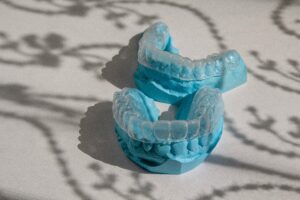 However, because they cannot be adjusted, they often fit poorly, feel bulky, and may interfere with breathing and speech. Children frequently remove them, defeating the purpose entirely.
- Boil-and-bite mouthguards: Made from a thermoplastic material, these are softened in hot water and then molded to the teeth by biting down. They offer a better fit than stock guards and remain the most commonly used type among young athletes. They are a reasonable middle-ground choice for casual or seasonal play.
- Custom-fitted mouthguards: Fabricated by a dentist from a precise impression or digital scan of your child’s mouth, these provide the most secure fit, the greatest comfort, and the strongest protection. Studies of athletes have consistently associated custom guards with lower injury rates than over-the-counter alternatives.7 Because they fit well, children are also far more likely to keep them in.
For a child who plays frequently, competes seriously, or wears braces, a custom guard is generally the most reliable investment. For occasional summer recreation, a quality boil-and-bite guard is far better than no protection at all.
Special Considerations for Children with Braces
Orthodontic treatment introduces additional risk. A blow to the face can drive the lips and cheeks into the metal brackets and wires, causing painful soft-tissue lacerations, and an impact may also damage the appliance itself—setting treatment back and adding cost.
Children undergoing orthodontic care should never use a standard boil-and-bite guard, which can interfere with tooth movement. Instead, a pediatric dentist or orthodontist can provide an appropriately designed guard that accommodates the hardware and can be adjusted as the teeth shift.
Caring for a Sports Mouth Guard
A guard only protects when it is clean, intact, and worn. To extend its life and keep it hygienic, encourage your child to:
- Rinse the guard with cool water or a mouth rinse before and after every use
- Brush it gently with a toothbrush and clean it periodically with mild soap
- Store it in a ventilated, rigid case—never loose in a gym bag
- Keep it away from heat and direct sunlight, which can warp the material
- Bring it to dental checkups so we can inspect the fit and condition
- Replace it when it shows tears, cracks, or no longer fits comfortably, especially as a child grows
When to See a Raleigh Dentist
If your child plays summer sports, the most reliable path to lasting protection is a custom-fitted guard made by a professional. Our team at our office routinely fits young athletes throughout the Triangle, and we are glad to be among the best dentists in Raleigh, Garner, Cary, Morrisville, Wake Forest, and Pittsboro, NC, who help families protect their children’s smiles before injuries occur. A visit allows us to assess your child’s bite, account for any orthodontic treatment, and create a guard that fits well enough that they will actually wear it.
If a dental injury has already happened, prompt care is essential. A knocked-out permanent tooth, in particular, is a true dental emergency: keeping the tooth moist and reaching a dentist within the first hour offers the best chance of saving it. We encourage parents to keep our number accessible during the active summer months.
Wells Family Dental is committed to both prevention and timely treatment. Contact us today to learn more or to schedule an appointment.
Frequently Asked Questions About Oral Cancer
At what age should a child start wearing a mouthguard for sports?
There is no rigid age to start. As soon as a child participates in any activity with a risk of facial impact—often as early as five or six in organized leagues—a properly fitted guard is appropriate. Because children’s mouths change rapidly, the fit should be checked regularly and the guard replaced as they grow.
Are mouthguards only necessary for contact sports like football?
No, many injuries occur in sports commonly considered “non-contact,” such as basketball and baseball, where elbows, balls, and falls cause significant trauma. The ADA recommends protection for any activity carrying a meaningful risk of dental injury, which includes most popular summer sports.
Is a custom mouthguard really worth the cost over a store-bought one?
For frequent or competitive young athletes, generally, yes. Custom guards fit more securely, are more comfortable, and have been linked to lower injury rates in clinical studies. Just as important, a comfortable guard is one your child will keep in—an ill-fitting drugstore version often ends up in a pocket.
My child wears braces. Can they still use a mouthguard?
Yes, and protection is especially important during orthodontic treatment. However, they should not use a standard boil-and-bite product. A dentist or orthodontist can provide a guard designed to fit over braces safely and adjust it as treatment progresses.
How often should a mouthguard be replaced?
Replace a guard whenever it becomes torn, cracked, or loose, or when it no longer fits because of growth or shifting teeth. For growing children, this may mean a new guard each season. Bring it to routine checkups so we can evaluate it.
References
- Amanda Pope, “Sports safety: avoiding mouth injuries,” UAB News, University of Alabama at Birmingham, October 2016, https://www.uab.edu/news/news-you-can-use/sports-safety-avoiding-mouth-injuries.
- “Athletic mouth protectors (mouthguards),” American Dental Association, August 2025, https://www.ada.org/resources/ada-library/oral-health-topics/athletic-mouth-protectors-mouthguards.
- “Policy Prevention of Sports-Related Orofacial Injuries,” American Academy of Pediatric Dentistry, January 2023, https://www.aapd.org/research/oral-health-policies–recommendations/prevention-of-sports-related-orofacial-injuries/.
- Ke Wang, Yitong Liu, Zihe Zhao, et al., “Mouthguard types, properties and influence on performance in sport activities: a narrative review,” Frontiers in Medicine, January 2025, https://pmc.ncbi.nlm.nih.gov/articles/PMC11810891/.
- “Protecting teeth with mouthguards,” The Journal of the American Dental Association, Vol. 137, Iss. 12, December 2006, https://jada.ada.org/article/S0002-8177(14)64806-6/fulltext.
- “Athletic mouth protectors (mouthguards),” American Dental Association, August 2025, https://www.ada.org/resources/ada-library/oral-health-topics/athletic-mouth-protectors-mouthguards.
- Ibid.

Dr. Brett Wells is the founder of Loren Dental, DentalHQ.com, and Wells Family Dental Group, which was recently awarded the Triangle Business Journal’s “2024 Best Places to Work” recognition. Dr. Wells has more than 20 years of experience practicing general and family dentistry, and has published widely in major medical journals, like Dental Economics and Inside Dentistry, on topics ranging from navigating dental insurance to advice for other dental practices and the impact of PPOs on dentistry. He is a graduate of the University of North Carolina-Chapel Hill Adams School of Dentistry and maintains memberships in various professional associations, including the American Dental Association, the Academy of General Dentistry, and the Dentist Entrepreneur Organization.
